

A tractor autosteer system uses GNSS positioning, correction data and steering controls to guide a tractor along planned passes, reducing the need for constant manual steering. A typical setup includes a GNSS receiver and antenna, a guidance display or controller, steering hardware and, when the work calls for greater precision, a correction source.
Field precision matters when consistent passes help limit overlap and missed areas. RTK correction can support high-precision tasks such as planting and bed preparation. This guide explains how autosteer works, when RTK is useful and what to consider in a DIY setup, so you can match the equipment to your tractor and field work.
Key Takeaways
- Understand how positioning, correction data and steering controls work together to guide tractor passes.
- Identify where consistent field guidance can help reduce overlap and missed areas in your operation.
- Match correction accuracy to the task, with RTK suited to work that demands higher precision.
- Assess an older tractor’s steering setup and compatibility before planning an autosteer retrofit.
How does an auto steer for tractor system work?
A tractor autosteer system combines satellite positioning, correction data, guidance software and steering hardware. It follows a selected path while you monitor the implement and field conditions. The main benefits are repeatable passes and less steering effort. Performance still depends on positioning quality and tractor compatibility.
Core Components and Steering Operation
The GNSS antenna and receiver determine the tractor’s position. Correction data refines that position when the task requires greater precision. On the display, you set guidance lines; a controller compares the tractor’s position with its planned track and sends steering commands through a wheel motor or hydraulic valve. For planting, set an AB line, engage guidance, then monitor tractor alignment and implement performance.
Check how the steering hardware connects to the tractor. A wheel motor turns the steering wheel and can be a retrofit option for some configurations. Hydraulic systems use a valve to direct fluid and steer the wheels. The right approach depends on the tractor’s steering design and kit compatibility, not just the task.
Assisted and Autonomous Steering
With assisted guidance, you steer while following the path shown on the display. An autosteer system actively turns the steering wheel or controls hydraulic steering to stay on that path. In either mode, you remain responsible for monitoring the tractor, implement and surroundings. Neither replaces operator attention during field work.
Hydraulic steering valve systems direct hydraulic flow to change the wheels’ direction. Compatibility depends on the tractor’s hydraulic steering arrangement and the system components. A wheel motor instead applies steering input at the steering wheel. Compare these approaches with your tractor setup, planned planting work and preference for hands-on steering.
Autosteer may not be worthwhile when a tractor handles occasional, short jobs or works in irregular areas with few repeated passes. Manual steering may meet those needs without adding system complexity. The benefits are more apparent when repeated guidance supports tasks such as planting across larger, regular fields.
Why does precision matter in modern farming?
Precision helps keep field operations consistent and can reduce overlap between passes. If a tractor repeatedly drifts from its intended line, it may leave untreated strips or cover the same ground twice. For planting, accurate guidance helps maintain planned row spacing. The value depends on the task, field layout, implement width and frequency of repeated passes.
Plan for the complete operation, not just the receiver. A typical setup needs a GNSS receiver and antenna, a display or controller, steering hardware and a correction source when greater accuracy is required. RTK correction can come from a base station or a network service. Your chosen correction method determines the equipment and signal access the work requires.
Electrical installation requires a suitable power connection, secure wiring and compatible tractor components. Before field work, position the antenna, enter implement details and calibrate the steering response. Then make a short pass and compare the tractor’s path with the intended guidance line. Calibration accounts for the tractor’s steering characteristics and the implement’s position.
Routine care includes securing connections, maintaining the antenna position and reviewing guidance settings when you change implements. If the operation relies on RTK correction, reliable access to the signal matters too. Useful technical support covers tractor compatibility, wiring, steering setup, calibration and correction configuration. These details help shape a practical installation plan.
Before selecting equipment, map your tractor model, steering type, implement and main field tasks. This gives you a clear basis for matching system components and correction needs. A smaller operation with irregular passes may need a different setup from regular planting work across aligned fields. For a closer look at available autosteer system options, consider how each setup fits your tractor and workflow.
Do you need RTK correction for accurate results?
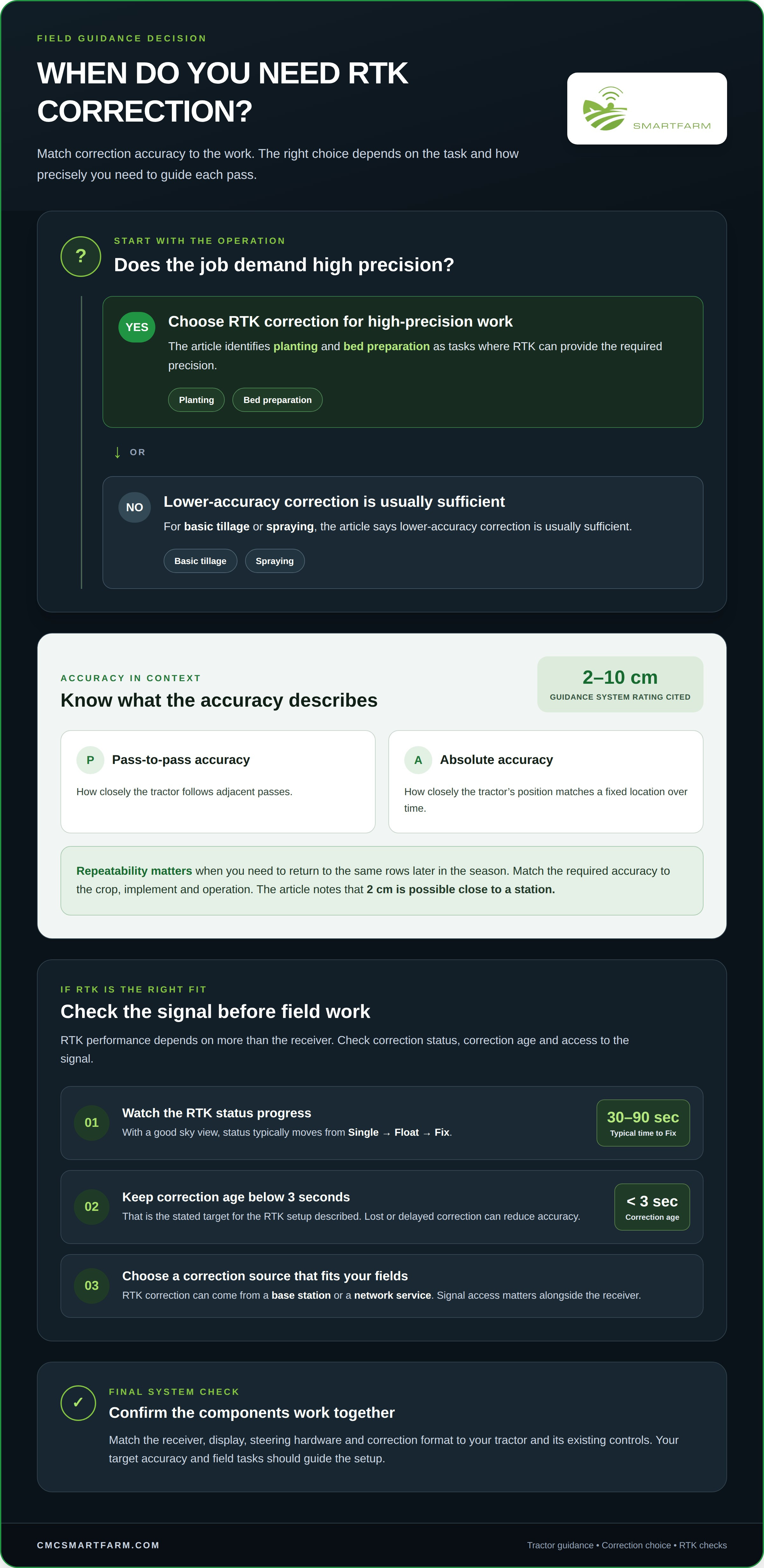
RTK correction suits operations that need high precision, including planting and bed preparation. For basic tillage or spraying, lower-accuracy correction is usually sufficient.
Accuracy and Repeatability
Compare pass-to-pass accuracy with absolute accuracy before choosing a guidance system. Pass-to-pass accuracy describes how closely the tractor follows adjacent passes. Absolute accuracy describes how closely its position matches a fixed location over time. Repeatability matters when you need to return to the same rows later in the season.
A guidance system rated at 2 to 10 cm can suit agricultural work; 2 cm is possible close to a station. Match the required accuracy to the crop, implement and operation. For example, planting needs consistent row placement, while a less exact task may tolerate wider variation.
RTK Guidance Accuracy
RTK correction can provide the precision required for planting or bed preparation. With a good sky view, RTK status typically moves from Single to Float to Fix in 30 to 90 seconds. The displayed status helps you see whether the receiver has reached an RTK fix before field work.
Correction age also affects guidance. Keep it below 3 seconds for the stated RTK setup. A lost or delayed correction can reduce accuracy, so the correction source and signal access matter alongside the receiver. Consider whether a local base station or network correction best fits your fields and operation.
Next, check compatibility. Match the receiver, display, steering hardware and correction format to the tractor and its existing controls. Then consider the season’s work: repeat planting may call for RTK, while basic tillage may suit a lower-accuracy signal.
Support should cover practical setup questions, including correction configuration, calibration and guidance-line settings. For example, changing from spraying to planting may require different guidance parameters. Choose a system whose components and support fit your tractor, target accuracy and field tasks.
Can autosteer be installed on an older tractor, and what does installation involve
Yes. Retrofit kits are available for some tractors that are several decades old. Fit depends on the tractor’s steering design, available mounting points, electrical system and the selected kit’s compatibility. An older model may be suitable, but age alone does not determine whether a setup will work.
Start by identifying the tractor model, steering type and intended field tasks. Then match the steering hardware to the machine. A wheel-motor setup turns the steering wheel, while hydraulic steering uses a valve to direct steering flow. Because these approaches require different components, compatibility should guide your choice.
Installation typically brings together the GNSS antenna and receiver, guidance display, controller and steering hardware. Secure the antenna where it has a clear view of the sky, and mount the display where you can read it from the operator’s seat. Route and secure power and signal cables away from moving parts and hot surfaces.
Electrical setup connects the guidance components to the tractor’s power supply. Follow the kit’s wiring requirements and protect connections from vibration and field debris. After fitting the components, enter the implement details and calibrate the steering response. A test pass helps confirm that the tractor follows its guidance line and the implement tracks as intended.
Older tractors may need extra attention during setup because steering and electrical layouts vary by model. A machine without an integrated steering interface, for example, may need a compatible retrofit method. The GNSS correction source also affects receiver configuration, especially when the work requires RTK guidance.
Plan the installation around tractor compatibility, steering method, antenna placement, wiring and calibration. Those checks connect the hardware to the work you need it to perform. Explore compatible autosteer options for your tractor and field operation.
CMC Dynamics SmartFarm
CMC Dynamics SmartFarm GmbH helps you match autosteer equipment to your tractor, steering setup and field tasks. Its range includes the AT2 Max Autosteering Kit, AT2 Auto Steer System, AS2 Steer-Ready Autosteering System and AH2 Hydraulic Auto Steer System. These configurations offer options to consider when planning guidance for your operation.
Use your tractor model, steering type, required accuracy and main field jobs to guide your choice. A steer-ready tractor and a machine requiring hydraulic steering call for different system considerations. CMC Dynamics SmartFarm GmbH provides expert advice to help assess compatibility and select equipment suited to your work, including whether RTK guidance is relevant.
Contact CMC Dynamics SmartFarm GmbH to discuss an autosteer setup for your tractor and field requirements.
Plan Your Next Step in the Field
Use your tractor, steering configuration and priority field tasks to define the right guidance setup. A tractor autosteer system should suit the machine you operate and the accuracy your work requires, without adding components your operation does not need.
CMC Dynamics SmartFarm GmbH offers the AT2 Max Autosteering Kit, AT2 Auto Steer System and AS2 Steer-Ready Autosteering System. Its team can help you assess these options against your tractor and field requirements, including steering compatibility and correction needs.
Take the next step with clear details about your tractor model, steering type and intended field tasks. Contact CMC Dynamics SmartFarm GmbH to discuss an autosteer setup and move forward with confidence.
Frequently Asked Questions
How does RTK connectivity stay reliable in rural or remote areas?
Track correction interruptions by field location and time, then look for patterns such as blocked signal areas or a weak mobile connection. Record when the guidance status changes and which parts of the field are affected. This evidence can help you choose a correction arrangement and plan around known signal gaps, rather than treating every interruption as a system fault.
How does a tractor autosteer system work?
During field work, the guidance controller continually compares the tractor’s reported position with its target path and adjusts steering to reduce the difference. You choose the path and manage the operation, including turns and field obstacles. For a first run, use a straight, unobstructed section and observe whether the tractor follows the line consistently before moving to a more complex area.
What are the main types of tractor autosteer systems?
Systems may be sold as retrofit kits, steer-ready configurations or hydraulic steering configurations. These labels describe different aspects of a setup, so they can overlap rather than form mutually exclusive categories. A retrofit kit describes how equipment is added to a tractor, while a hydraulic configuration identifies the steering interface. Check product descriptions for the exact configuration.
How accurate are GPS and RTK tractor autosteer systems?
Accuracy claims are most useful when you know the conditions and measurement method behind them. Check whether a specification describes pass-to-pass performance or positioning against a fixed reference, and note the correction mode. In field trials, compare guidance with a consistent reference line and record results across representative parts of the field, rather than relying on one short test pass.
What should you check before choosing a tractor autosteer system?
Check whether the system supports your tractor configuration and steering interface, and confirm which correction options it uses. Review the setup requirements and guidance workflow, then consider the field tasks you need it to handle. These checks help you compare systems based on fit and operation.
How do major tractor autosteer brands compare, including compatibility and support?
Compare brands using the same tractor model and field task as your reference case. Review product documentation for supported configurations, then assess how clearly each supplier explains setup, troubleshooting and system operation. Consider whether the guidance workflow suits the people who will operate the tractor. This keeps the comparison focused on your farm’s requirements, without relying on broad brand rankings or unsupported performance claims.